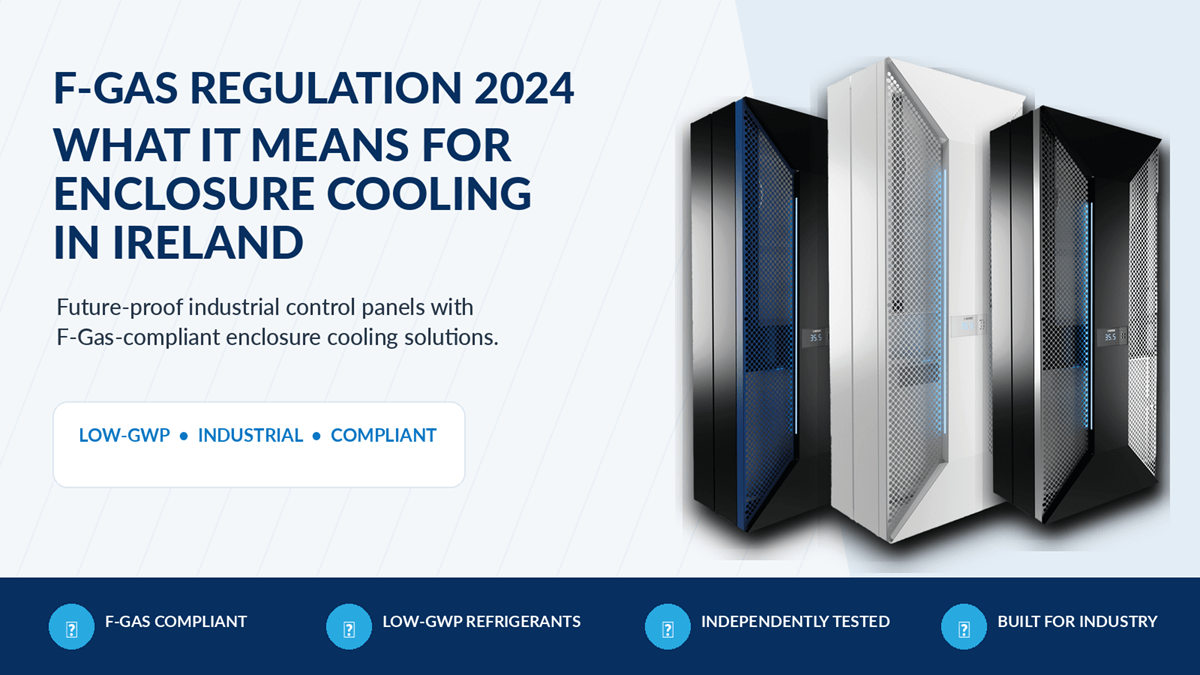
F-Gas Regulation & Enclosure Cooling in Ireland
The EU F-Gas Regulation 2024/573 became law in Ireland in March 2024, and it changes how every Irish panel builder, OEM and plant engineer specifies enclosure cooling. Refrigerants with high global warming potential (GWP) are being phased down hard, with key bans landing in 2027 and 2031. If your control panels rely on cooling units running R134a or similar HFCs, the clock is ticking on servicing, refrigerant supply and cost.
Demesne Electrical is the Irish distributor for Seifert Systems, whose entire current enclosure cooling range already complies with the new regulation. This guide covers what the rules require, which refrigerants survive past 2031, and why propane (R290) has become the industry's long-term answer.
Blog
What the F-Gas Regulation means for enclosure cooling
The regulation phases down fluorinated greenhouse gases across the EU by reducing the available HFC quota over time. Two dates are especially important for anyone specifying industrial cabinet cooling:
- 2027: high-GWP, non-flammable refrigerants are largely banned in new self-contained refrigeration equipment.
- 31 December 2031: approval ends for the A2L refrigerants R1234yf and R454C in this application. Natural refrigerants such as R290 remain the longer-term route.
Existing installed equipment can continue operating, but operators may have additional leak-checking and documentation obligations. As the available F-Gas quota reduces, refrigerant supply and servicing costs for older equipment may also increase.
There is also a proposed EU restriction on PFAS substances. This could affect several HFO refrigerants, including R1234yf. R290 is a natural, PFAS-free refrigerant and is not part of the F-Gas quota system.

The Seifert refrigerant strategy at a glance
Seifert uses three F-Gas-compliant refrigerant options across its industrial enclosure cooling range:
| Refrigerant | GWP | Cooling capacity | Safety class | EU approval |
|---|---|---|---|---|
| R290 (propane) | 0.02 | 0.2–2.8 kW | A3 | Indefinite |
| R1234yf | 0.501 | 0.3–4.0 kW | A2L | Until 31.12.2031 |
| R454C | 146 | 6.0 kW | A2L | Until 31.12.2031 |
R134a, which is still used in some older cabinet coolers, has a GWP of 1,430. By comparison, R290 has a GWP of 0.02, reducing the climate impact of the refrigerant charge to near zero.
Product imagery should be treated as representative unless the exact refrigerant used by each individual model has been confirmed.

Is R290 safe for industrial use?
Propane is classified as an A3 refrigerant because it is flammable. However, Seifert keeps the refrigerant charge in its R290 units below recognised safety limits.
The maximum R290 charge is 99 g, compared with a recognised 150 g threshold. Staying below this threshold provides several practical advantages:
- No prescribed room dimensions. The units can be installed wherever a standard enclosure cooling unit would normally be used.
- No additional safety measures during normal transport or operation.
- Approved for air freight, which is useful for panel builders and machinery manufacturers exporting internationally.
A 99 g refrigerant charge is approximately comparable with the propane charge in a domestic refrigerator. An 11 kg barbecue gas cylinder contains roughly the same amount of propane as 110 units using a 99 g charge.
The refrigeration circuit is fully sealed, so refrigerant cannot flow into the electrical enclosure.
Independently certified
Seifert units are tested and certified to recognised industrial safety standards, including EN 378, EN IEC 60335-2-40, UL 60335-2-40 and CSA C22.2 No. 60335-2-40.
The range also undergoes leak and safety testing, TÜV Nord testing and an independent risk assessment. For Irish machinery manufacturers exporting to the United States or Canada, the UL and CSA listings can help simplify the certification process.


Why not just switch to R1234yf or R513A?
R1234yf is suitable for current applications, and Seifert uses it where higher cooling capacities are required. However, A2L refrigerants are not the permanent long-term answer for this application.
EU approval for R1234yf and R454C in this application ends on 31 December 2031. The proposed PFAS restriction could also affect some HFO refrigerants. Specifying an A2L refrigerant today may therefore require another specification change during the equipment’s working life.
R290 offers a longer-term route because it is a natural refrigerant, has a very low GWP and falls outside the F-Gas quota system.
Frequently asked questions
What are the F-Gas standards?
EU F-Gas Regulation 2024/573 governs fluorinated greenhouse gases across EU member states, including Ireland. It introduces GWP limits, reduces the available F-Gas quota and sets requirements for equipment containing fluorinated refrigerants.
What is an enclosure air conditioner?
An enclosure air conditioner, also called a cabinet cooler or panel cooling unit, is mounted on an electrical enclosure. It removes heat generated by drives, PLCs and power electronics while helping prevent dust and ambient air from entering the cabinet.
Is F-Gas the same as refrigerant?
No. F-Gases are one category of refrigerants and include fluorinated gases such as R134a and R1234yf. Natural refrigerants such as propane, CO2 and ammonia do not contain fluorine.
Do I have to replace my existing cooling units?
Existing equipment may continue operating, subject to the relevant servicing, leak-checking and record-keeping requirements. Many operators plan to replace older units with R290 equipment when the existing system reaches the end of its useful life.
Where can I buy Seifert cooling units in Ireland?
Demesne Electrical, the Irish distributor for Seifert Systems. Our team can help select a compliant cooling unit based on enclosure size, heat load and operating conditions.
Contact our team about Seifert enclosure cooling.
[email protected] |+353 1 404 7780.png?mh=450&mw=450&hash=02B6BFB34C0C65FCD80517A5D6AEF592)

.png?mh=450&mw=450&hash=4827FDA152143783C74109CC92490CAE)